Swimming is more than just moving through water. The way you swim, known as your stroke, determines how effective your workout is, how many calories you burn , and how quickly you improve.
Whether you are a beginner learning the basics or someone looking to improve performance, understanding different swimming strokes helps you train smarter and get better results.
This guide explains all the main swimming strokes in detail, including technique, muscles worked, calorie burn, difficulty level, and who each stroke is best suited for, so you can train with a clear purpose and get the full health benefits of swimming instead of just moving across the pool
What Are Swimming Strokes?
Swimming strokes are the different techniques used to move through water. Each stroke has its own rhythm, breathing pattern, and muscle engagement.
While there are many variations, most training and fitness routines focus on four primary strokes:
- Freestyle (front crawl)
- Breaststroke
- Backstroke
- Butterfly
Each serves a different purpose depending on your fitness level and goals.
Quick Comparison of Swimming Strokes
Here is a quick overview before we go deep on each one:
|
Stroke
|
Difficulty
|
Calorie Burn (30 min)
|
Primary Muscles
|
Best For
|
|
Freestyle (Front Crawl)
|
Beginner–Intermediate
|
300–325 kcal
|
Shoulders, lats, core, legs
|
Speed, weight loss, overall fitness
|
|
Breaststroke
|
Beginner
|
200–250 kcal
|
Chest, inner thighs, triceps
|
Beginners, cardio, casual fitness
|
|
Butterfly
|
Advanced
|
400–450 kcal
|
Back, shoulders, chest, core
|
Max calorie burn, core strength
|
|
Backstroke
|
Intermediate
|
250–300 kcal
|
Back, glutes, hamstrings, shoulders
|
Posture, spinal alignment, back pain
|
|
Sidestroke
|
Beginner
|
180–200 kcal
|
Obliques, legs, shoulders
|
Long distance, relaxed swimming
|
|
Elementary Backstroke
|
Beginner
|
160–180 kcal
|
Arms, legs, back
|
Absolute beginners, relaxation
|
Calorie estimates based on a 70 kg adult at moderate intensity.
1. Freestyle: The Most Efficient and Widely Used Stroke
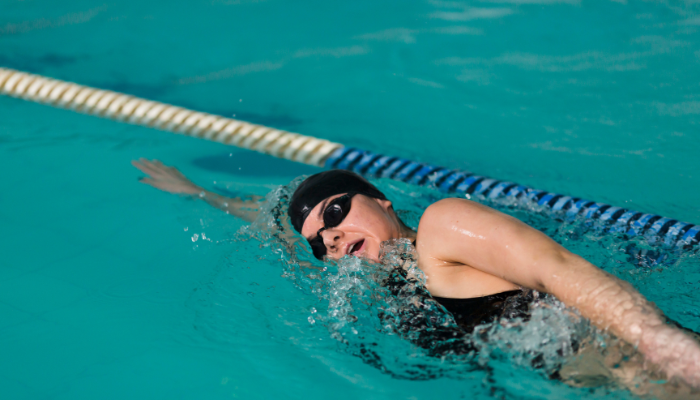
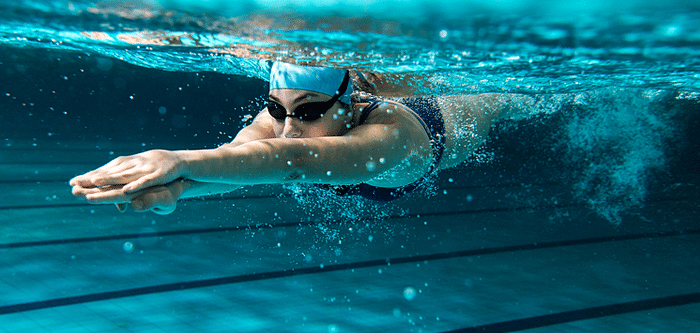
Freestyle, also called front crawl, is the fastest, most efficient, and most widely practised swimming stroke in the world. It is the default stroke in open-water swimming and the first one most intermediate swimmers develop beyond the basics.
How to Swim Freestyle: Step-by-Step Technique
Body position:
- Lie horizontally face-down in the water, body as flat and streamlined as possible
- Keep your head in a neutral position, eyes looking slightly forward and down, not straight ahead
- Hips should stay near the surface; let your legs trail behind naturally
Arm movement:
- Arms alternate in a continuous overhead pull cycle
- Entry: extend one arm forward, fingers together, entering the water at shoulder width and not across the centre line
- Pull: bend the elbow and pull your hand back through the water in an S-curve toward your hip (the "high elbow" position)
- Recovery: lift the elbow first, swing the arm forward over the water surface in a relaxed arc
- While one arm pulls, the other extends forward, there should always be one arm working underwater
Leg kick:
- Flutter kick — alternating up-down movement from the hip, not the knee
- Keep feet relaxed and slightly pointed (not rigid), toes pointed behind you
- 6-beat kick (6 kicks per arm cycle) is standard for sprint; 2-beat kick is more efficient for distance
Breathing:
- Rotate your head to one side as the arm on that side recovers — do not lift your head straight up
- Exhale continuously underwater through nose and mouth; inhale quickly on the rotation
- Breathe every 2, 3, or 4 strokes — bilateral breathing (alternating sides every 3 strokes) prevents muscular imbalance
Muscles Worked in Freestyle
- Primary: Latissimus dorsi (back), deltoids (shoulders), triceps, core (transverse abdominis, obliques)
- Secondary: Quadriceps, hamstrings, glutes, hip flexors (flutter kick), forearms
Benefits of Freestyle Swimming
- Offers the highest sustainable speed among all swimming strokes, making it ideal for regular fitness and lap swimming
- Burns around 300 to 325 calories in 30 minutes at a moderate pace
- Helps build shoulder strength, improves upper back definition, and strengthens the core
- Works as an efficient cardiovascular workout by keeping your heart rate consistently elevated
- Suitable for swimmers aiming to build endurance for open-water swimming or triathlon training
Who Should do Freestyle swimming
Best for:
- Intermediate swimmers
- Weight loss and endurance training
- Anyone looking for a primary workout stroke
Not ideal for:
- Absolute beginners uncomfortable with breathing technique
2. Breaststroke
Breaststroke is the oldest recorded swimming stroke and the most natural-feeling for most beginners. It is the only stroke where your head stays above water for most of the cycle, making breathing easier and reducing the anxiety many new swimmers feel.
How to Swim Breaststroke (Simplified)
- Body position: Flat with slight rise and dip
- Arms: Move together in a circular motion
- Kick: Frog-style kick provides most of the power
- Breathing: Lift your head naturally during the pull
Muscles Worked in Breaststroke
- Primary: Pectorals (chest), inner thighs (adductors), triceps, hip flexors
- Secondary: Biceps, quadriceps, core, glutes
- Breaststroke is the only stroke that significantly activates the inner thighs
Benefits of Breaststroke & Best For
- One of the easiest strokes for beginners, as the breathing position feels natural and reduces fear in the water
- Targets inner thighs and hip muscles that are often not trained in regular gym workouts
- Can be done at a low intensity, making it useful for recovery between harder swim sessions
- Provides a steady cardiovascular workout without feeling too exhausting
- Includes a glide phase that gives short breaks, making it easier to swim for longer durations
Absolute beginners, casual swimmers, older adults, and anyone who prefers to keep their head above water. Also useful as an active recovery stroke between butterfly or freestyle intervals.
Difficulty: Beginner
Common mistake: Not gliding, rushing straight from kick to pull without pausing in the streamlined position
3. Butterfly Stroke
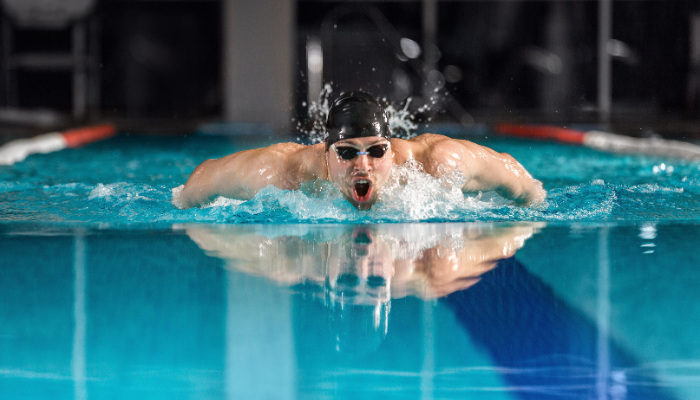
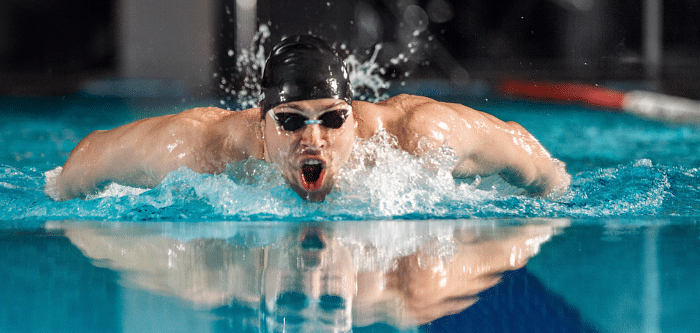
Butterfly is the most technically demanding and physically exhausting stroke in swimming. It requires full-body coordination, significant core strength, and good shoulder mobility. When done correctly, it looks effortless and powerful; done incorrectly, it is extremely inefficient and tiring.
How to Swim Butterfly (Simplified)
- Body position: Wave-like motion through the water
- Arms: Move together in a powerful pull
- Kick: Dolphin kick (both legs move together)
- Breathing: Lift head forward, not sideways
Muscles Worked in Butterfly
- Primary: Latissimus dorsi, trapezius, pectorals, core (entire anterior and posterior chain)
- Secondary: Deltoids, triceps, quadriceps, hamstrings, glutes, hip flexors
- Butterfly is the most complete full-body muscular effort of any stroke
Benefits of Butterfly Stroke
- Burns the most calories of all strokes (400–450 kcal per 30 minutes)
- Builds exceptional core strength, spinal stability, and postural control
- Develops explosive upper-body power
- Improves hip flexibility and thoracic spine mobility over time
- The undulating motion strengthens deep stabiliser muscles that no other stroke targets
Who Should Use It
Best for:
- Advanced swimmers
- Strength-focused workouts
Not recommended for:
- Beginners or people with shoulder issues
4. Backstroke
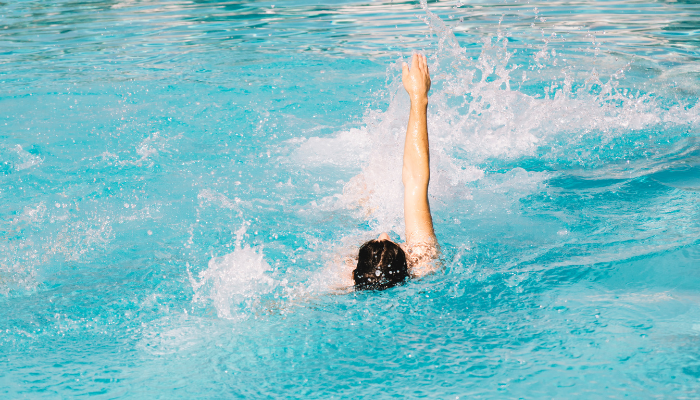
Backstroke is the only competitive stroke swum on your back. This fundamentally changes the experience - you can breathe freely throughout, there is no face-in-water anxiety, and your spine stays in a comfortable neutral extension. It is one of the most therapeutic strokes for people with back and neck tension.
How to Swim Backstroke: Step-by-Step Technique
Body position:
- Lie on your back, ears submerged, eyes looking straight up at the ceiling or sky
- Hips should stay near the surface - a common mistake is letting the hips sink, which creates drag
- Keep your core engaged to maintain a flat, streamlined body line
Arm movement:
- Arms alternate, similar rhythm to freestyle but in reverse
- Entry: one arm reaches straight back over the shoulder and enters the water with the pinky finger leading (not the palm)
- Pull: bend the elbow and pull the arm down and back toward your hip in a sweeping arc
- Recovery: lift the arm straight up toward the ceiling and rotate it back over the shoulder
- Keep shoulders rotating and the body rolls side to side; only your head stays still
Leg kick:
- Flutter kick - same principle as freestyle but inverted
- Kick originates from the hip, not the knee
- Toes pointed, feet slightly pigeon-toed, ankles relaxed
- The upbeat (foot kicking upward toward the surface) provides the propulsion
Breathing:
- Breathe whenever you want — your face is always out of the water
- Establish a consistent breathing rhythm tied to your arm stroke for better efficiency
Muscles Worked in Backstroke
- Primary: Latissimus dorsi, rhomboids (mid-back), posterior deltoids, glutes, hamstrings
- Secondary: Core stabilisers, triceps, hip flexors, quadriceps
- Backstroke is particularly effective for strengthening the posterior chain — the back, glutes, and hamstrings
Benefits of Backstroke
- The face-up position allows free breathing, this is ideal for swimmers with breathing anxiety in water
- Stretches and strengthens the thoracic spine and upper back muscles that tighten from desk-based work
- Excellent for improving posture and counteracts the forward-rounding posture most people develop
- Recommended by physiotherapists for swimmers managing lower back pain or cervical (neck) tension
- Good calorie-burning stroke (250–300 kcal per 30 min) at a comfortable intensity
Best For
Intermediate swimmers, people with back pain or postural issues, those recovering from shoulder injuries (compared to butterfly), and swimmers who want a productive workout without face-in-water discomfort.
Difficulty: Intermediate
Common mistake: Looking forward or sideways, keep eyes fixed at the ceiling to maintain body position
Other Swimming Strokes Worth Knowing
Sidestroke
Sidestroke is swum on your side - one arm pulls, one arm pushes, legs perform a scissor kick. It is not a competitive stroke but remains valuable for lifeguard training, long-distance endurance swimming, and recreational swimming. Because only one arm works at a time and the body is turned sideways to reduce drag, sidestroke is extremely energy-efficient, useful when you need to cover distance without exhausting yourself. It is also easier on the shoulders than freestyle.
Best for: Long-distance swimming, lifesaving, recreational swimmers, or as a low-intensity endurance set.
Elementary Backstroke
Elementary backstroke is a simplified version of backstroke designed for absolute beginners and swimmers in water safety training. Both arms sweep out and back simultaneously (like a "chicken wing" motion) while the legs perform a simple frog kick — the same kick as breaststroke. There is no over-water arm recovery, making it very accessible and non-threatening for new swimmers.
Best for: True beginners, elderly swimmers, water rehabilitation, and anyone building comfort in water before learning a formal stroke.
Which Swimming Stroke Is Best for Your Goal?
Not every swimmer has the same objective. Here is how to choose your starting point:
- If you are a complete beginner: Start with breaststroke or elementary backstroke
- If you want to lose weight: Prioritise freestyle and butterfly, these are highest sustained calorie burn
- If you have back or neck pain: Backstroke is your best option
- If you want a full-body athletic challenge: Butterfly is unmatched for total muscle engagement and core development
- If you want efficient long-distance swimming: Freestyle or sidestroke
- If you are cross-training from another sport: Freestyle builds cardio and upper-body endurance; backstroke aids recovery and posture
How Long Does It Take to Learn Each Stroke?
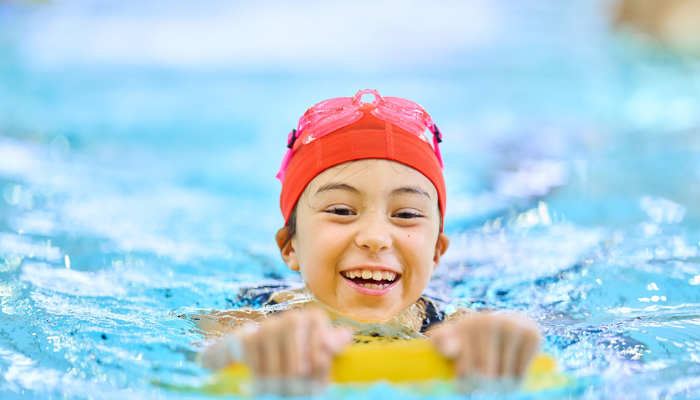
This depends on your comfort level in water, frequency of practice, and whether you have guided coaching. As a general benchmark:
|
Stroke
|
Approximate Time to Basic Proficiency
|
|
Elementary Backstroke
|
1–2 sessions with guidance
|
|
Breaststroke
|
3–6 sessions
|
|
Backstroke
|
4–8 sessions
|
|
Freestyle
|
6–12 sessions
|
|
Butterfly
|
3–6 months of consistent practice
|
These timelines assume 2–3 coached sessions per week. Self-taught swimmers typically take longer because incorrect technique becomes harder to unlearn later.
Common Swimming Technique Mistakes (And How to Fix Them)
Knowing the stroke is one thing but avoiding the mistakes that slow you down and cause injury is another.
|
Mistake
|
Stroke Affected
|
Fix
|
|
Lifting head straight up to breathe
|
Freestyle
|
Rotate head sideways, one goggle in the water
|
|
Skipping the glide phase
|
Breaststroke
|
Pause in streamline position for 1–2 seconds
|
|
Bending knees too much on dolphin kick
|
Butterfly
|
Drive the kick from hips, not knees
|
|
Letting hips sink
|
Backstroke
|
Engage core and keep hips pressed toward the surface
|
|
Arms crossing the centre line on entry
|
Freestyle
|
Enter each arm at shoulder width, not across your nose
|
|
Rushing the arm recovery in butterfly
|
Butterfly
|
Slow down , efficiency beats effort every time
|
Make Swimming Part of Your Routine
Swimming strokes are not just techniques, they define how effective your workout will be. Choosing the right stroke based on your goals can help you improve faster, avoid injuries, and stay consistent. By understanding how each stroke works and when to use it, you turn swimming into a structured, results-driven fitness activity rather than just a casual exercise.
One of the biggest barriers to swimming regularly is access to facilities. With FITPASS, you can explore and access swimming pools across multiple locations , making it easier to stay consistent without being tied to a single venue.