Loading...
loading...
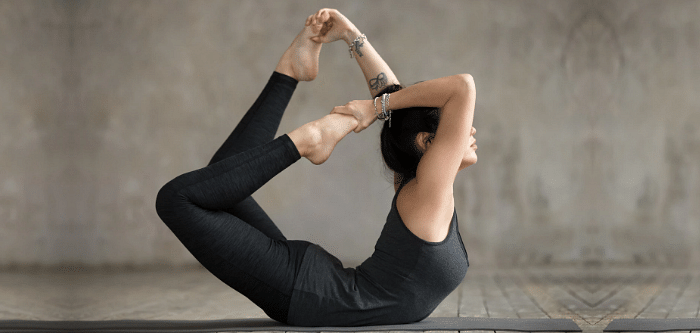

The Dhanurasana is a deep back-bending pose that involves lying on your stomach and holding your ankles with your arms. This results in a great curving of your body and makes it look like a bow, hence the name Bow Pose.
There are a plethora of benefits to practising the Dhanurasana. Key among them is the strengthening of your upper, lower and middle back, developing your core, improving flexibility of the spine, strengthening biceps and triceps, and many more.
To do the Dhanurasana correctly, follow the steps given above carefully and keep the following tips in mind:
Yes, beginners can also perform the Dhanurasana, although performing the purna dhanurasana may be challenging for some. Beginners may not be able to completely reach their ankles at first. In those cases, one can always use a strap to cover the extra distance. Once the pose becomes easier, the arms will reach further and one can stop using the strap.


Table of Contents:
The Dhanurasana yoga pose is one of the most beneficial hatha yoga asanas. Also called the bow pose, the Dhanurasana is a back-bending pose that involves considerable flexibility and stretching to transform your body into the shape of a bow. The name itself is derived from the Sanskrit words Dhanur meaning bow and asana meaning pose.
At first glance, the Dhanurasana may seem very challenging, but we’ll give you some excellent tips and techniques to successfully perform this pose accurately. But first, let us understand the pose and its diverse benefits in detail.
The Dhanurasana pose involves the whole body, focusing on the back, leg and arm muscles. It’s such a great pose to strengthen the back and core and improve your flexibility.
The main muscles engaged during a Dhanurasana pose are:
Your core muscles bear the brunt of any load you carry. They also aid in your posture and agility. The Dhanurasana is a brilliant asana for increased strength and flexibility of your core muscles.
Most of the effort that goes into performing bow pose yoga is carried out by your spine. It improves the curvature of your spine to prevent slouching and increases flexibility. Spine problems like slip disc and back pain. This may be the best yoga asana for people who spend long hours sitting at a desk, putting their spine in a compromised position.
The Dhanurasana works on the upper back, strengthening the muscles comprising it. This results in greater flexibility and agility in your back.
The Dhanurasana yoga asana requires great flexibility of arms and shoulders. That’s why regularly performing this pose will not only strengthen your biceps and triceps but also your shoulders.
Here’s how you can begin mastering the bow pose:
Initially, if you’re a beginner, you may not have the flexibility right at the outset to reach your ankles with your hands., In that case, you can use a strap to wrap around your feet and pull on that instead.
Once you master the Dhanurasana, you can try variations of it, like the more challenging Purna Bhujangasana.
For more technical guidance on the Dhanurasana and other yoga asanas, download FITPASS, your one-stop solution to everything fitness. You not only make it very easy to find yoga classes near you but also get the opportunity to sign up for FITCOACH, our cutting-edge AI fitness coach that can help you plan the best yoga routines that suit your fitness goals.