A strong lower back is the foundation of total-body strength and athletic performance. Whether you're looking to increase your deadlift, improve your squat stability, or build a powerful physique, developing your lower back muscles is essential for reaching your fitness goals.
The lower back comprises primarily the erector spinae, multifidus, and quadratus lumborum muscles and plays a critical role in stabilizing your spine during heavy lifts. Lower back transfers power from your lower body to your upper body, and supports your entire posterior chain. Training these muscles not only enhances your strength but also improves your posture and movement efficiency during both training and daily activities.
This guide covers the best lower back exercises that focus on building strength, control, and endurance. These exercises are suitable for beginners as well as experienced fitness enthusiasts when performed with proper form.
Why Lower Back Strength Matters
Building a strong lower back delivers multiple performance benefits that extend beyond isolated muscle development:
- Enhanced Lifting Performance: Your lower back stabilizes your spine during heavy compound movements like deadlifts, squats, and rows. A stronger lower back means you can handle heavier loads with better form and reduced injury risk.
- Improved Athletic Power: The lower back acts as a crucial link in the kinetic chain, transferring force from your legs through your torso during explosive movements like jumping, sprinting, and throwing.
- Better Posture and Movement Quality: Strong erector spinae muscles help maintain proper spinal alignment throughout the day, whether you're sitting at a desk or standing for extended periods.
- Injury Prevention: A well-developed lower back provides essential support during both training and daily activities, reducing the risk of strain or injury when lifting objects or performing dynamic movements.
- Total-Body Strength Foundation: Your lower back works synergistically with your core, glutes, and hamstrings to create a powerful posterior chain that supports virtually every athletic movement pattern.
Key Muscles Involved in Lower Back Strength
Lower back exercises primarily target:
- Erector spinae - muscles that support spinal extension and posture
- Core muscles - provide stability and control
- Glutes - help offload stress from the lower back during movement
Training these muscles together creates a strong foundation for full-body strength.
The 10 Best Lower Back Exercises for Maximum Strength
1. Superman Hold
The superman is a fundamental bodyweight exercise that builds isometric strength and endurance in your entire posterior chain.

Equipment: None (bodyweight)
Difficulty: Beginner
Reps: Hold for 15-30 seconds, 2-3 sets
How to Perform:
- Lie face down on the floor or an exercise mat with your arms extended overhead and legs straight
- Engage your core and simultaneously lift your arms, chest, and legs off the ground
- Keep your neck neutral by looking down at the floor throughout the movement
- Hold the top position while maintaining tension in your lower back and glutes
- Lower back to the starting position with control
Progression: Once you can hold for 30 seconds easily, try single-arm or single-leg variations, or add ankle weights and wrist weights for increased resistance.
Form Cues:
- Squeeze your glutes at the top position to maximize posterior chain activation
- Avoid hyperextending your neck and keep it aligned with your spine
- Focus on lifting through your lower back rather than just throwing your limbs up
2. Bird Dog
This exercise improves lower back control and coordination by challenging balance.

Equipment: None (bodyweight)
Difficulty: Beginner
Reps: 10–12 reps per side
How to Perform:
- Start on your hands and knees in a tabletop position with hands under shoulders and knees under hips
- Engage your core to create a neutral spine position
- Simultaneously extend your right arm forward and left leg backward until both are parallel to the floor
- Hold this position while maintaining a stable torso without rotating or tilting
- Return to the starting position and repeat on the opposite side (left arm, right leg)
Progression: Add ankle weights or hold dumbbells to increase difficulty. You can also slow down the tempo to 5-second holds for greater time under tension.
Form Cues:
- Imagine balancing a cup of water on your lower back and avoid any twisting or tilting
- Extend through your heel and fingertips to maximize reach and muscle activation
- Keep your hips level throughout the entire movement
3. Back Extension (Hyperextension)
A controlled movement that directly targets the lower back muscles.

Difficulty: Intermediate
How to Perform:
- Position yourself on a hyperextension bench with your hips resting on the pad and ankles secured
- Start with your torso perpendicular to the floor and hands crossed over your chest or behind your head
- Hinge at the hips and lower your torso forward until you feel a stretch in your hamstrings and lower back
- Reverse the movement by contracting your lower back and glutes to raise your torso back to the starting position
- Stop when your body forms a straight line from head to heels—avoid hyperextending past neutral
Progression: Hold a weight plate against your chest, use a barbell across your upper back, or add a resistance band for progressive overload.
Form Cues:
- Focus on the eccentric (lowering) phase for maximum muscle development
- Don't go too far up, stop at a straight body line to avoid excessive spinal extension
- Squeeze your glutes hard at the top to take pressure off your spine
4. Deadlift (Light to Moderate Weight)
The deadlift is the king of lower back exercises, building total-body strength with emphasis on the entire posterior chain.

Equipment: Barbell and weight plates
Difficulty: Intermediate to Advanced
Reps: 6-10 reps (focus on form)
How to Perform (Conventional Deadlift):
- Stand with feet hip-width apart, barbell over the middle of your feet
- Hinge at your hips and bend your knees to grip the bar just outside your shins
- Create tension by engaging your lats, bracing your core, and flattening your back
- Drive through your heels and extend your hips and knees simultaneously to lift the bar
- Keep the bar close to your body as you stand up to full hip and knee extension
- Reverse the movement by pushing your hips back first, then bending your knees to lower the bar
Progression: Follow a progressive overload protocol, adding 2.5-5kg per week as your strength improves. Consider using Romanian deadlift variations for more direct lower back emphasis.
Form Cues:
- Set your back before initiating the pull, never lift with a rounded spine
- Think of "pushing the floor away" rather than pulling the bar up
- Full body tension is critical, squeeze everything tight before you lift
5. Good Mornings (Advanced)
Good mornings are a hip-hinge movement that builds tremendous strength throughout your posterior chain, particularly your lower back.

Equipment: Barbell (can start with bodyweight or resistance band)
Difficulty: Intermediate to Advanced
Reps: 8–10 reps
How to Perform:
- Stand with feet hip-width apart and a barbell resting across your upper traps (as in a back squat position)
- Brace your core and maintain a neutral spine throughout the movement
- Initiate the movement by pushing your hips backward while hinging at the waist
- Lower your torso forward until it's nearly parallel to the floor or you feel a deep stretch in your hamstrings
- Drive through your heels and contract your glutes and lower back to return to the starting position
Progression: Gradually increase the weight on the barbell as you master the movement pattern. Start with just the bar or even bodyweight until your form is perfect.
Form Cues:
- Keep your knees slightly bent but relatively fixed throughout the movement
- Maintain a neutral spine and never round your lower back under load
- Think "hip hinge" not "back bend", the movement should come from your hips
6. Romanian Deadlift
This variation emphasises controlled hip movement and lower back engagement.

How to Perform:
- Push hips back while keeping the back flat
- Lower weights slowly
- Return to standing using glutes and lower back
7. Reverse Hyperextension
Reverse hyperextensions target your lower back, glutes, and hamstrings while minimizing spinal compression.
Equipment: Reverse hyperextension machine or bench
Difficulty: Intermediate
How to Perform:
- Lie face down on a reverse hyperextension machine or flat bench with your hips at the edge
- Grip the handles or bench for stability
- Let your legs hang down toward the floor in the starting position
- Contract your glutes and lower back to lift your legs up until they're in line with your torso
- Hold briefly at the top, then lower your legs back down with control
Progression: Add ankle weights or hold a dumbbell between your feet for increased resistance.
Form Cues:
- Don't swing or use momentum - control the entire range of motion
- Squeeze your glutes hard at the top to maximize posterior chain activation
- Avoid lifting your legs too high past parallel to prevent excessive spinal extension
8. Kettlebell Swing
Kettlebell swings develop explosive power and dynamic strength throughout your posterior chain.

Equipment: Kettlebell
Difficulty: Intermediate
How to Perform:
- Stand with feet shoulder-width apart, kettlebell on the floor between your feet
- Hinge at your hips and grip the kettlebell with both hands
- Hike the kettlebell back between your legs while maintaining a neutral spine
- Explosively drive your hips forward to propel the kettlebell up to chest height
- Let the kettlebell swing back down between your legs as you hinge again, then repeat
Progression: Increase kettlebell weight or perform single-arm swings for greater anti-rotation demands.
9. Glute Bridge
While primarily a glute exercise, glute bridges significantly strengthen your lower back through hip extension.
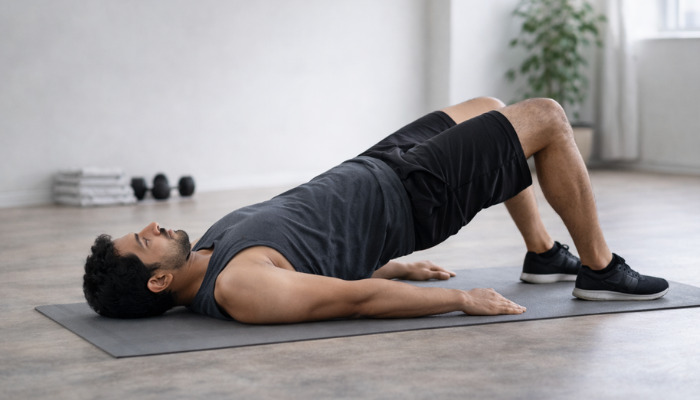
Primary Muscles: Glutes, hamstrings, erector spinae
Equipment: None (bodyweight), can add barbell for hip thrusts
Difficulty: Beginner
How to Perform:
- Lie on your back with knees bent and feet flat on the floor, hip-width apart
- Place your arms at your sides with palms facing down
- Brace your core and drive through your heels to lift your hips toward the ceiling
- At the top, your body should form a straight line from shoulders to knees
- Squeeze your glutes hard for 1-2 seconds at the top
- Lower your hips back down with control
Progression: Progress to single-leg glute bridges, add a resistance band above your knees, or place a barbell across your hips for weighted hip thrusts.
Form Cues:
- Drive through your heels, not your toes
- Avoid overarching your lower back at the top, maintain neutral spine
- Squeeze your glutes as hard as possible at the peak contraction
10. Plank with Hip Extension
This dynamic plank variation combines core stability with lower back and glute strengthening.

Equipment: None (bodyweight)
Difficulty: Intermediate
How to Perform:
- Start in a forearm plank position with elbows under shoulders and body in a straight line
- Engage your core to maintain a neutral spine
- Lift your right leg off the ground, extending it straight back while squeezing your glute
- Hold for 2-3 seconds, then lower with control
- Alternate legs for the prescribed number of reps
Progression: Add ankle weights or increase hold time at the top position.
Form Cues:
- Don't let your hips sag or rotate when lifting your leg
- Keep your core maximally engaged throughout
- Focus on posterior chain activation, not how high you can lift your leg
How Often Should You Train Your Lower Back?
For optimal strength development without overtraining, train your lower back 2-3 times per week with at least 48 hours of recovery between sessions. Your training frequency will depend on several factors:
- Direct Lower Back Training: If you're performing dedicated lower back exercises like back extensions or good mornings, 2-3 sessions per week is ideal.
- Compound Lift Integration: If you're already performing heavy deadlifts and squats in your program, your lower back is getting significant stimulus from those movements. In this case, add 1-2 supplementary lower back exercises after your main lifts.
- Recovery Considerations: Your lower back is involved in virtually every major compound movement, so ensure adequate recovery. If you're feeling excessive fatigue or soreness, reduce training frequency or volume.
Common Mistakes to Avoid
- Using Momentum Instead of Control: Swinging or jerking through movements reduces time under tension and increases injury risk. Keep every rep controlled and deliberate.
- Neglecting Progressive Overload: Your muscles adapt to stimulus over time. Consistently challenge yourself by adding reps, sets, weight, or time under tension.
- Ignoring the Eccentric Phase: The lowering portion of each exercise is crucial for strength development. Take 2-3 seconds to lower with control.
- Overarching at the Top: Excessive hyperextension puts unnecessary stress on your spine. Stop at neutral spine position during exercises like back extensions and supermans.
- Training Through Sharp Pain: Muscle fatigue and soreness are normal, but sharp or shooting pain is not. If you experience pain, stop the exercise and consult a fitness professional.
Build Your Foundation for Total-Body Strength
Building a strong lower back is essential for long-term fitness, posture, and movement efficiency. By incorporating the right mix of bodyweight, stability, and strength exercises, you can develop a lower back that supports your workouts and daily activities.
Consistency, proper form, and gradual progression are the keys to lasting results. As your lower back gets stronger, it becomes the foundation for better performance, improved lifting technique, and a more resilient body.